
Wild Geese Farm-Full for 2026
WILD GEESE FARM-Full for 2026
1 APPRENTICESHIP
PART TIME/FULL TIME (30-40 hours/week)
APPROX START/END DATES: Mid March - Mid December
$16.50/HR
LOCATION: West Linn(Portland Chapter)
YEARS IN PRODUCTION: 1
PREVIOUS YEARS HOSTING: New Host Farm
PRACTICES: Mechanized/Tractor Farming
ACRES IN CULTIVATION: 10
Vegetable Production, Cut Flowers
ON-FARM HOUSING? No
VEHICLE REQUIRED? Yes/No
LANGUAGES SPOKEN: English
Wild Geese Farm was started at the historic Luscher Farm in Lake Oswego by Braedon Kwiecien and Sidney Katz. Our mission is to care for the environment while we feed our community nutrient-rich food. We value delicious food, great friends, and a healthy planet. We’ve always felt a deep purpose to care for the planet. For us, farming is a way to contribute to our community while caring for the Earth. Over the years, we’ve grown a lot of vegetables, raised many kinds of animals, and cooked so much delicious food. We learned some of the best techniques to improve the soil and care for animals as we grow food for our community.
https://www.wildgeesefarm.com/about
https://www.instagram.com/wildgeesefarm/?hl=en
FARM OVERVIEW
Wild Geese Farm is a 12-acre diversified vegetable farm on Lake Oswego city land that is surrounded by a park and community garden plots. From the fields, you can see children playing soccer, families walking together and 100s of locals tending their own gardens. It is a working farm that inspires people in the area, educates people on local food production, and encourages cooperation through volunteering. An urban farm comes with inherent challenges, but the opportunities to demystify food production for the public, collaborate with people, and grow hyper-local food make this location a unique business setting.
We grow vegetables on 12-acres of land without using conventional fertilizers or sprays. We cover crop to improve soil quality, reduce erosion and sequester carbon as much as we can throughout the year. We use tractors on the farm judiciously to be efficient, productive, and ease the strain on our bodies, while we try to reduce negative impacts like compaction, erosion, and consumption of fossil fuels. We use electric, light-weight machines as much as we can and continue to be mindful of our systems. Our vegetables are sold through a market-style CSA that is distributed at the farm so that no transportation is needed. And we will sell at the Lake Oswego farmer’s market this year. Our crew is a very small team consisting of 2-4 individuals throughout the year, which means we all do everything, work together and learn a lot over the season.
Braedon Kwiecien is the owner of Wild Geese Farm and has worked on nearly a dozen different farms before, learning best practices, new farming techniques and gaining a broad range of experiences over the years. He has worked on organic vegetable farms, in orchards, vineyards and has raised pigs, sheep and chicken. His philosophy and vision are inspired by closed-loop, integrated farming systems that mimic nature. He is interested in management-intensive grazing, silvopasture, no-till organic vegetable production, and community farming.
Wild Geese Farm is going into its second year of production and is focused on improving the following systems: stale seed bedding for effective weed management with less soil disturbance, irrigation monitoring to reduce water usage, improved soil health using bacteria and fungus, and diverse cover crop rotations. We’re excited to have a new electric cultivation tractor for the upcoming season to reduce time spent weeding and fossil fuel use. Hopefully we can spend more of our time planting, harvesting and taking excellent care of the land.
TRAINING AND EXPECTATIONS
Apprentices can expect to do almost every task on the farm: seeding, transplanting, amending, weeding, harvesting, washing, and distributing. With a small crew there will be plenty of opportunity to develop specific skills such as seeding in the propagation house, tractor driving, flame weeding and learning to use specialized tools.
At the beginning of the season, it will be understood that apprentices need time to learn about the space, the farm’s systems and to feel welcome and acclimated to the new job. Time will be dedicated to education and learning new skills. It’s our belief that taking time to teach more people skills is good for everyone and pays off in the long term. As the season progresses, focus will shift to honing skills, improving efficiency and exploring more facets of farming.
There is an expectation that apprentices will be fully integrated into the team, have a sense of responsibility, agency and are capable of carrying out their share of the operation with an adequate level of quality in their work. A lot of our work in this small crew is done together, and I will likely always be able to chat, offer feedback and facilitate education.
Farming is a physically demanding job and is exhausting. Apprentices are expected to work hard alongside everyone else. We also expect everyone to be safe and feel cared for. Particularly in the summer, we will take plenty of breaks, hang out in the cooler and reduce our time spent in the heat. In the winter, I will regularly check in to see if people are warm, dry, and if they are equipped with the right gear to feel comfortable in the elements.
We can offer apprentices time off as needed throughout the season for sick days, vacation, or emergencies. We have the capacity to be lenient and flexible when it comes to days off.
QUALIFICATIONS
We are looking for an apprentice who is passionate about farming, holds a sense of responsibility for their commitments, and has a deep desire to learn and improve their skills as a farmer. Previous farming experience is a bonus but not necessary.
COMPENSATION / ACCOMMODATIONS
We can offer $16.50 per hour at a minimum, or more with prior experience. We will also offer $100 gear stipend, flexibility for time off (24 hours of PTO/year) and a weekly CSA plus extra vegetables when available.
We do not provide on farm housing. However, the farm is located in an urban setting with a lot of housing opportunities within a very reasonable distance.
EQUITY AND INCLUSION
We welcome people of all ages, gender identities and races. And we are committed to teaching everybody the same skills. We recognize that historically non- cis-, white men have been overlooked to use heavy equipment, to be managers and to specialize. That’s one reason why we are committed to rectifying that pattern and encouraging opportunity and growth for everybody on the farm.
We are also committed to accommodate to abilities and adjust to conditions. We will regularly check in about how a tool fits someone’s body and how tasks are suiting them. We will always take feedback about what tasks are challenging and why, and how we can accommodate them. We will provide many options for adjusting the height and weight in many tasks and even change jobs that someone is uncomfortable in if it is reasonable.
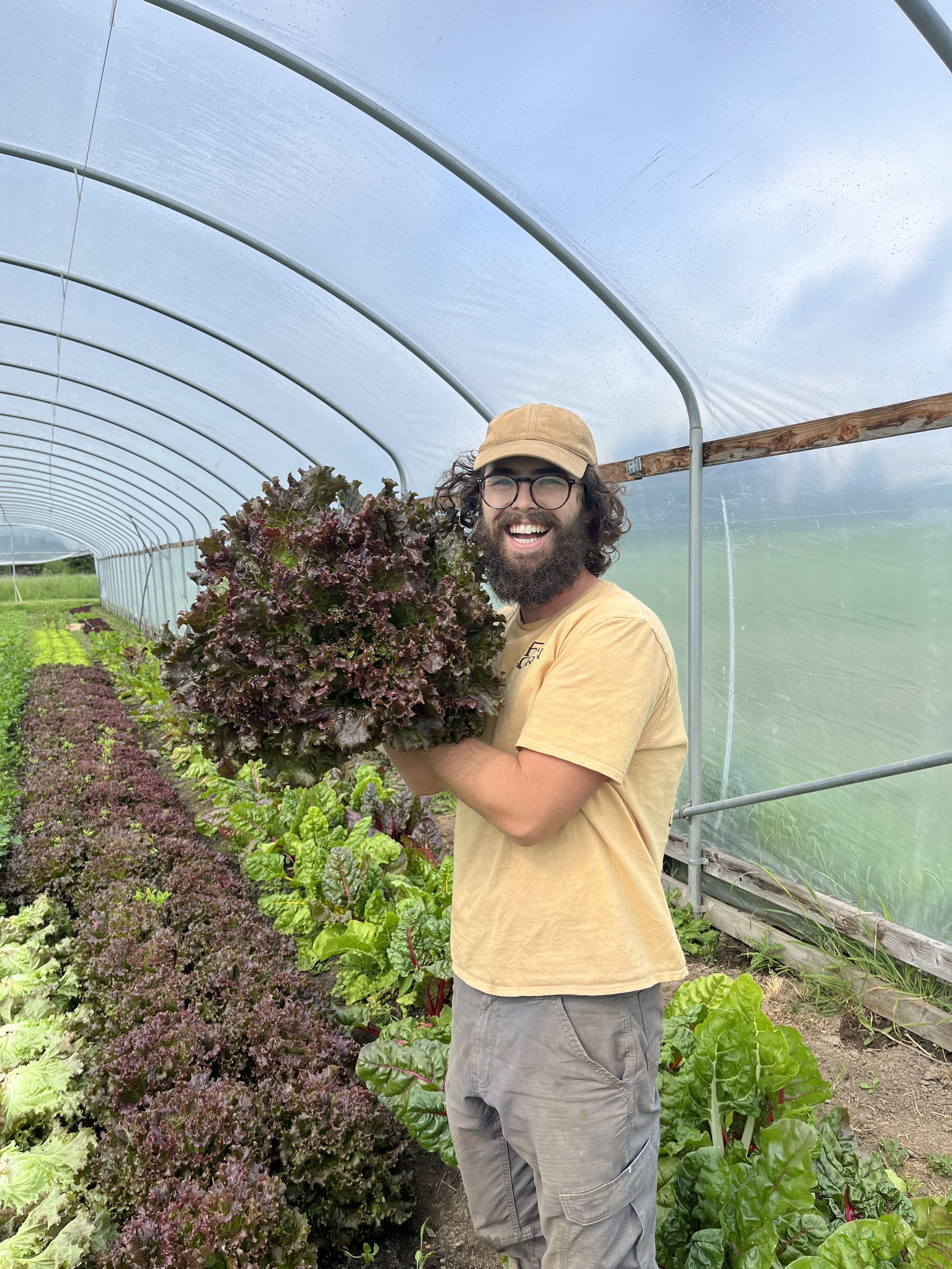
Farm Owner, Braedon
