
all current participating mentor host farms with Oregon Farm Corps farmer training programs
Sweet Union Farm - FULL FOR 2026
Oregon Farm Corps Apprentice Position at Sweet Union Farm
At Sweet Union Farm, we believe that vegetables are beautiful, land is to be respected and community is our strength. We are passionate about growing the highest quality vegetables for our community and making them accessible to everyone. We seek balance, intentionality and excellence in all we do ecologically, socially and economically.
SWEET UNION FARM
1 APPRENTICESHIPS - FULL FOR 2026
PART TIME (20-24 hours/week)
APPROX START/END DATES: Mid April - Late October
$17/HR
LOCATION: Klamath Falls (Southern Oregon* / Satellite)
YEARS IN PRODUCTION: 9
PREVIOUS YEARS HOSTING: 2
PRACTICES: Low-Till, No-Till, Organic Practices (Not Certified)
ACRES IN CULTIVATION: 1
Vegetable Production, Nursery, Sheep
ON-FARM HOUSING? No
VEHICLE REQUIRED? Yes
LANGUAGES SPOKEN: English , Spanish
*While outside of the Rogue Valley Chapter, some in-person educational events will be within a 90-minute drive from this Host Farm. Attendance at these events is highly encouraged.
At Sweet Union Farm, we believe that vegetables are beautiful, land is to be respected and community is our strength. We are passionate about growing the highest quality vegetables for our community and making them accessible to everyone. We seek balance, intentionality and excellence in all we do ecologically, socially and economically.
Katie Swanson has been farming for 10 years and just completed her ninth season owning/operating Sweet Union Farm. Sweet Union’s farm Enterprises are diversified vegetables. Our sales outlets include Farmer's market, restaurants, farm-to-school and the local food hub Klamath Grown. Sweet Union is a very intensively managed and productive small farm. Sustainability is a top priority in making this farm healthy for all the species that live here, emphasizing diversity, soil-building, and water saving.
FARM OVERVIEW
Sweet Union Farm sits on the occupied land of the Klamath and Modoc tribes who cared for this beautiful place since time immemorial. Currently, what the community refers to as “The Tribes” are the Klamath, Modoc and Yahooskin tribes which are headquartered about 25 minutes north of the farm. Since federal recognition was restored in the 80s, The Tribes have been doing incredible community-building work, leading public health and environmental efforts that make Klamath Falls a better place to live.
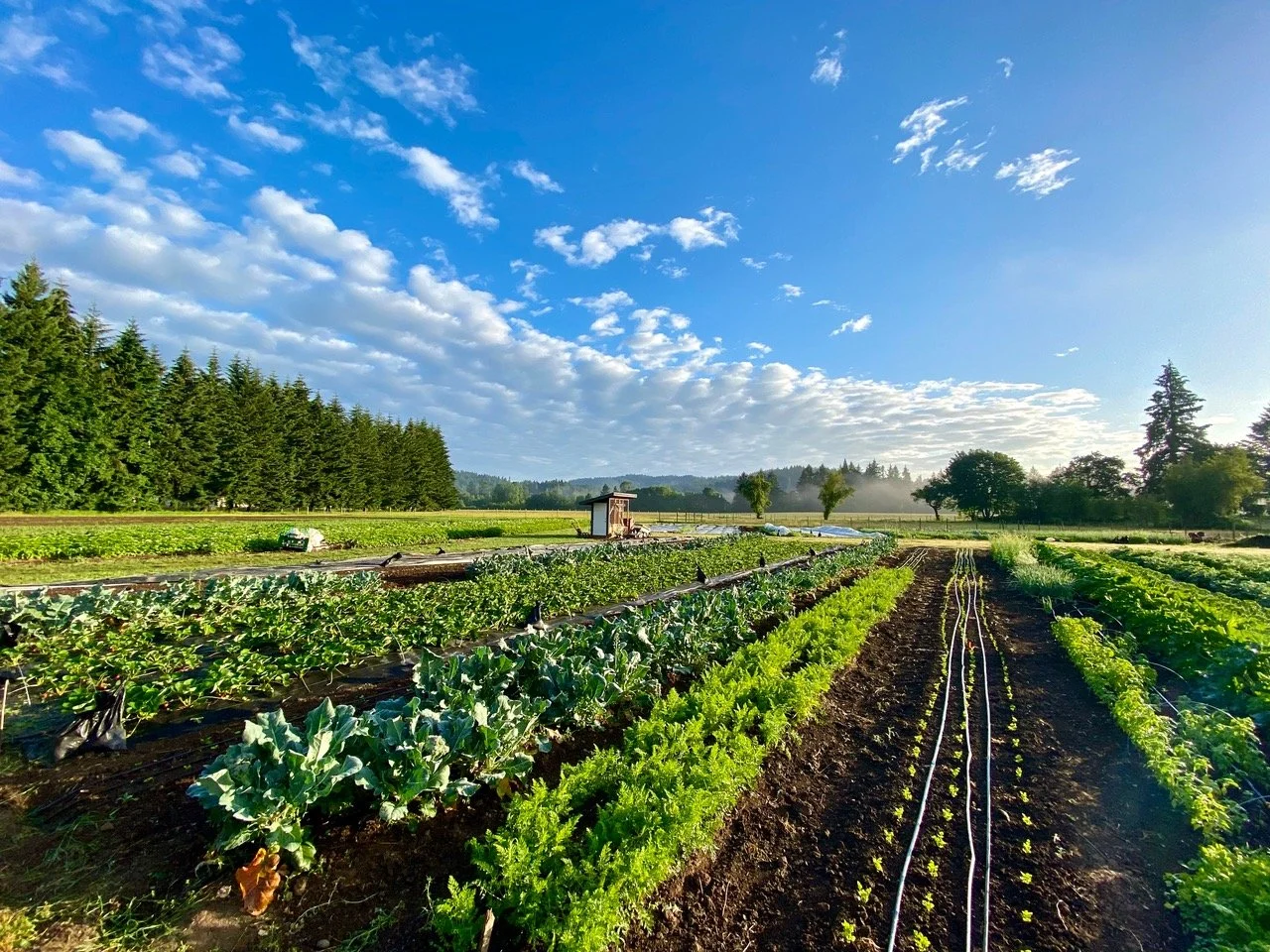
I, Katie Swanson, have lived in Oregon my whole life, growing up in Gresham and Boring. My husband and I live in our home on the farm. We had our first child, John River, born August 2024. The Farm is about 10 minutes southeast of the metro area of Klamath Falls. The property is 7.5 acres total with about 1 acre in vegetable production and the rest is a mix of pasture, outbuildings, a home garden, irrigation pond and riparian habitat along the river. Our property is surrounded by a mix of similar sized hobby farms and a few much larger farm operations with hills in the distance and the Lost River running alongside the north edge. It’s very peaceful with lots of birds but is also very close to town.
Klamath Falls is a small city of about 45,000 people and the county seat for Klamath County, which has a population of about 70,000. Klamath has a small town feel, but because it’s the city center for a remote region, it has an energy to it with lots of great small businesses. It’s surrounded partially by wide open spaces of agricultural land (mainly hay, grain, potatoes, cattle, horseradish, garlic, etc.) as well as lakes, mountains and forests which provide endless outdoor recreation. It’s a mountain biking destination and the lakes provide lots of opportunities for canoeing, sailing, kayaking, SUP, etc. Crater Lake National Park is about an hour away to the north and the Lava Beds National Monument is 45 minutes to the south. The wide open skies make for some great sunsets and the high desert climate means lots of dry, sunny days. Klamath Falls is definitely experiencing an increase in population; some people like to say we’re the next Bend, but I like to think our grit gives us our own, unique character.
Living in a dry, drought-prone climate, water-saving efficiencies have become more and more of a focus every year on the farm. One of the main focuses is increasing the water-holding capacity of the soil through building organic matter with cover crops and compost and minimal tillage techniques. We use compost, cover crops and natural fertilizers to build the soil and are working to mitigate the compaction that has occurred due to the practices of previous owners.
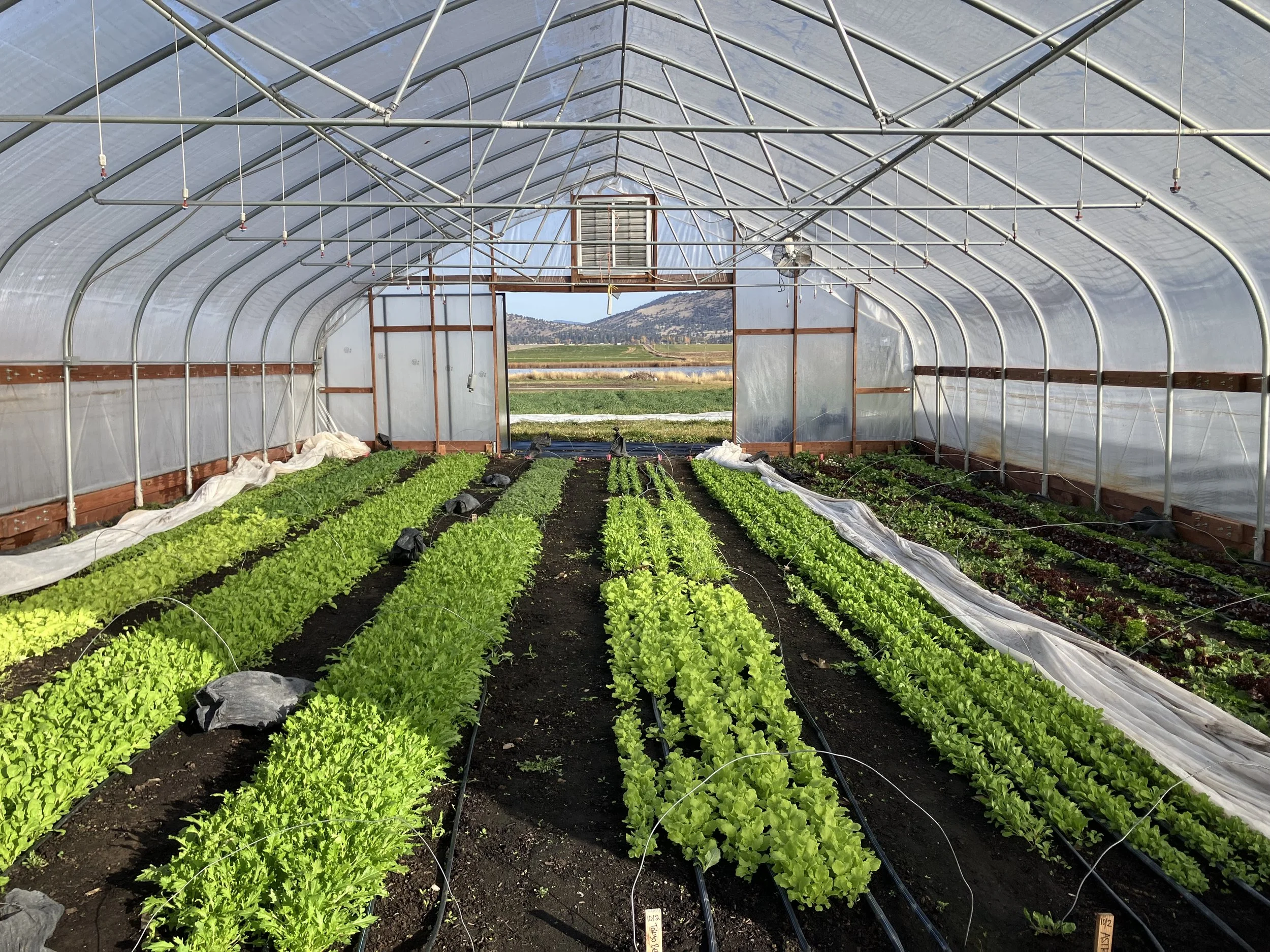
We do a mix of hand work and mechanized with the tractor and BCS. We transplant by hand as well as use the Paperpot transplanter and use a jang seeder for direct seeding. We use tarps to suppress weeds and break down old crops. Drip tape is mostly used for irrigation, plus some overhead (micro sprinklers and handlines) for specific uses. We have one unheated high tunnel and are building another minimally heated tunnel this winter.
A few other production methods we use are crop rotation, planting hedgerows and borders of pollinator-friendly flowers and herbs, interplanting, natural fertilizers and various Integrated Pest Management techniques. We are always experimenting and trying new things. Pigs are raised on pasture and get lots of farm scraps.
About Katie: Katie believes growing good food and making it accessible while taking care of the land is the best thing she can do for her community. Besides farming, Katie loves to be with her family, paddle on the water (canoe, kayak, SUP), search for wildflowers, camp, cross country ski, drink tea and cuddle with Kitty Ben.
Katie did not grow up farming, but always had a garden and some animals. She taught high school for five years, but fell in love with farming thanks to the thriving women-led small farm scene in the Portland area. She worked on a few different farms, including WWOOFing in Peru and working at 47th Avenue Farm in Portland. Katie started Sweet Union Farm in 2016 on one of the busiest roads in Klamath while working at Blue Zones Project as a food systems manager. Starting on about a quarter acre, she grew over 100 varieties of vegetables for CSA and restaurant customers and slowly expanded by leasing land. In the winter between the 2021 and 2022 season, she and Dallas were fortunate enough to move to their current property. During the 2022 season on the new property, Katie scaled down, got to know the land and built infrastructure, then re-started full farm operations again in 2023. Katie also co-founded and is heavily involved in Klamath Grown, a non-profit food hub that aims to build a strong and equitable local and regional food system.
TRAINING AND EXPECTATIONS
For the 2026 season, The crew will mostly consist of myself, one returning full-time employee and one OFC Apprentice. There may be one other part-time employee that runs the farmers market booth. .
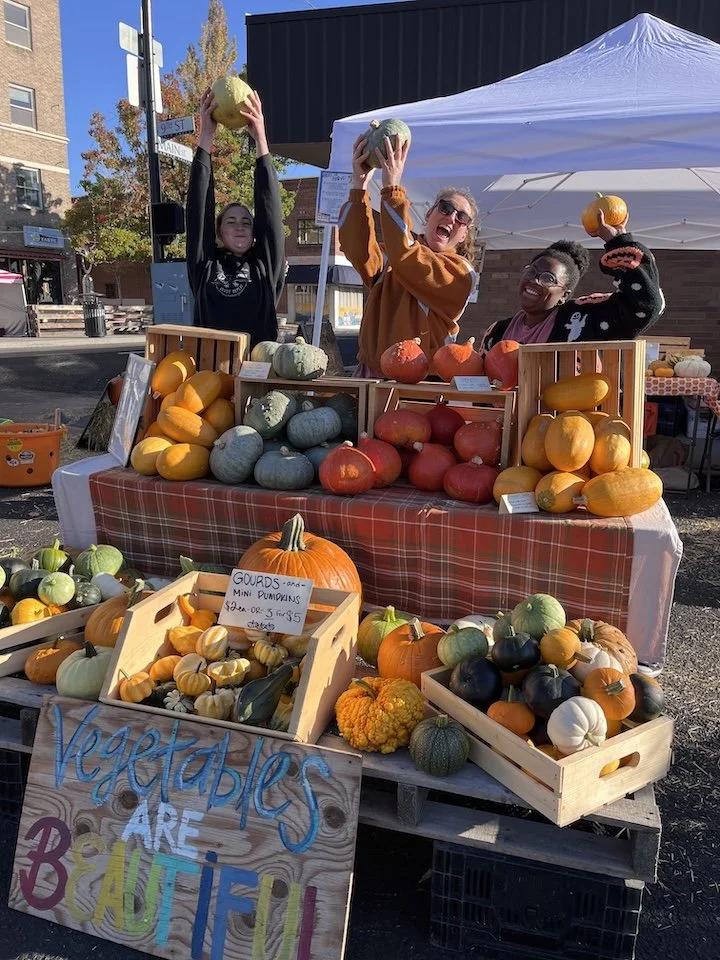
The Apprentice will gain experience in annual vegetable production in the following ways: flipping and prepping beds (hand tools, tarps & BCS), direct seeding (Jang), transplanting (by hand & Paperpot), greenhouse seeding, cultivation and weed management, season extension techniques, irrigation, harvest, wash & pack. Tractor training can be discussed, although this is typically reserved for one crew member per season who has at least one season on the farm. Apprentices will learn about the various sales outlets and have opportunities to work the farmers market booth. There may also be opportunities to work on other projects around the property, such as managing and expanding the native plant hedgerows and riparian habitat. We will also have a few sheep that they can help take care of. The apprentice will also be involved in our spring plant sale where we sell veggie starts and native plants. Additionally, there will be opportunities to learn about the back end of farming and how we manage the business. We also typically host a few field trips every year, so the Apprentice can learn how to lead a class field trip on the farm. If the apprentice has another particular area of interest, I will do my best to arrange the schedule so that they can participate in that aspect of the farm.
In addition to farm work and farm business management, the Apprentice will have the opportunity to learn about community food systems work and how to develop partnerships in order to increase access to produce. Katie is the co-founder of the local food hub, Klamath Grown, so there is ample opportunity to get involved in that work.
The specifics of the schedule for 2026 are still being worked out. The days per week may vary between 2-3. The average day is 8 hours, although it can range from 6-10 hours depending on a variety of factors. There is the option to apply for the farmers market position which involves 1 day/week running our Saturday farmers market booth. All state laws regarding breaks and lunch are observed.
The Apprentice is expected to be able to do physical work in all types of weather and be on their feet for the hours described above with the ability to lift 40 pounds repeatedly. Provided training, the ability to operate equipment such as the BCS is important as well as other hand tools used on the farm.
More than anything, a positive attitude, willingness to learn and ask questions, and open communication would be expected of the apprentice. Beyond the on-farm communication, the Apprentice would be expected to communicate kindly and clearly to customers.
We tend to utilize the “I do, we do, you do” format where we show the mentee how to do a task then do it with them providing feedback and answering questions. Once it feels like they have the hang of it, we give them space and do something else then come back to check in to see if they have any questions. At the beginning of the season we would expect to be doing more tasks side by side and as they learn more and fewer tasks are new, they would work more independently.
We typically have a weekly check in and review the plan with the whole crew once a week, plus daily morning check-ins to clarify who is doing what and to provide any explanations.
A lot of discussions and mentoring naturally happen while we are working, but Katie also schedules individual check-ins with each staff member at least 2-3 times per season to discuss how they are doing physically, mentally and emotionally on the farm. These will also be times to touch base on what they are learning to make sure their goals are being met.
The Apprentice would have access to the farm library of 20+ farming books. Plus, we will inevitably share online resources with each other, podcasts, watch videos, etc. which would fuel great discussions in the field. I also recognize that people come from a diversity of backgrounds with different communication and learning styles, so I would ask them about their preferences at the beginning of the season and adjust accordingly. The apprentice is also welcome and encouraged to take on a project of their own on the farm. Once they arrive and get a feel for the place, we can talk about their ideas, see how they fit into the existing farm systems and discuss how to best support their project.
QUALIFICATIONS
At least one season of agricultural experience is preferred but not required. Most important is experience doing physical labor outdoors.
Strong communication skills, ability to self-advocate and communicate needs
Ability to work efficiently and consistently with others and independently
Ability to follow instructions, open to constructive feedback
Positive attitude and ability to have a good time while being productive.
Learner mindset, asks questions and shares ideas from own experience.
Observant, attention to detail and takes initiative to fill needs or solve problems
Strong work ethic, desire to do high quality work
Ability to do physical work in all weather
Provided training, ability to operate hand tools and equipment, including the BCS.
Ability to lift 40 pounds repeatedly
Clean drivers license and reliable vehicle to get to work on time
An in-person visit is preferable, but if that is not possible, we can work around that.
COMPENSATION / ACCOMMODATIONS
$17/hr.
$150 equipment stipend after 60 days
Paid PTO (accrual rate 1 hr per 30 hrs worked plus 4 additional hours after 60 days)
Access to lots of farm veggies
$200 bonus when the season completed
Limit of 3 personal days off during peak season (late May - mid September), not including sick time, approved in advance. Vacation requests need to be scheduled at least 2 weeks in advance and coordinated with the farm schedule and rest of the crew so that no two people are off at the same time. Unless discussed at least 2-3 months in advance, time off requests are not likely to be approved during May and September.
No Housing Offered.
EQUITY AND INCLUSION
At Sweet Union, we strive to maintain a welcoming spirit and create a safe and inclusive environment where everyone is valued and respected for who they are. We do that by caring for each other and seeing each other as more than a laborer, but a whole, complex and unique human being. We help each other out, encourage each other, use kind and respectful language, and take a collaborative approach to solving problems on the farm. We stretch together before each harvest and check in with how our bodies are doing, making adjustments to the work plan as needed to allow for self care. We do a lot of check-ins to make sure each individual’s needs are met, they feel supported and that they are finding joy in their work. We welcome people of all backgrounds and strive to be open and honest about our faults while constantly doing the personal, inner work that we see as our own responsibility.
Klamath Falls is a place that struggles with poverty, water scarcity, and white supremacy among other things. In that context, I take the role of a farm business like Sweet Union very seriously. As a white woman in agriculture, I have a responsibility to speak out against white supremacy and inequity of all kinds. At a community level, I am working with the non-profit, Klamath Grown, to prioritize social justice within the organization and the broader local food promotion work. The farm also supports the local Pride Festival every year. Ag and inclusivity haven’t always been paired together in this community, but the hope is to start changing that and for there to be no doubt where Sweet Union Farm stands on the Black Lives Matter movement, Indigenous rights, LGBTQ+ rights or other social justice issues.
Farm values & philosophy:
At Sweet Union Farm, we believe that vegetables are beautiful, land is to be respected and community is our strength. We are passionate about growing the highest quality vegetables for our community and making them accessible to everyone. We seek balance, intentionality and excellence in all we do ecologically, socially and economically.
At Sweet Union Farm, the vegetables are beautiful. We share that beauty with the community when we:
Produce vegetables that are beautiful inside and out. This means that we provide consistently fresh, high-quality, diverse and delicious vegetables that thrive in our climate through sustainable and efficient farm management practices.
Inspire our customers to cook with and enjoy the uniqueness of fresh and local vegetables.
Maintain a tidy and beautiful environment that serves as an inspiration for all who visit the farm.
Prioritize professionalism, kindness and trust in all our community relationships.
Always seek to improve our systems with a holistic lens.
At Sweet Union, the land is respected. We are grateful to grow in such a beautiful place. In our efforts to be respectful and filled with gratitude, we:
Relish in working within the boundaries of our place, considering the climate and natural resources of the high desert (formerly a wetland basin, which is now drained and irrigated farmland and desert). We pay particular attention to soil health, efficient water management, and plant varieties that thrive in this environment.
Value all parts of the farm ecosystem, including those that don’t produce cash crops by planting flowers for pollinators and implementing no or low-till systems that respect the microbial life in the soil.
Recognize and seek to better understand the reciprocal relationship between the land and ourselves. We have much to learn from the natural systems around us.
Are always improving, testing, innovating, learning and questioning our farm management practices with the goal to become more sustainable and regenerative. We are grateful for the teachers in our lives.
We recognize that none of these practices are new and most sustainable farming methods were developed long ago by the original, Indigenous stewards of this land.
Our community is strong and we are fortunate to be a part of it. We feel a strong sense of purpose and as part of our commitment to community-building, we:
Maintain a welcoming spirit and strive to create a safe and inclusive environment where all customers, employees, volunteers and visitors to the farm feel valued, respected and are treated as equals.
Seek to build a stronger, more equitable and inclusive food system through collaboration and partnership with people and organizations who share these values.
Increase access to nourishing and regionally appropriate food for the people of Klamath Falls as well as connect them to the land and each other through food.
Choose to fight against an oppressive food system which has systematically disenfranchised Black, Indigenous and People of Color. We choose to be honest about our supporting role in this violent system, both historically and presently, as we seek to educate ourselves so we can do better and move ourselves and our farm towards justice.
Prioritize balance in our lives and time to care for ourselves, which in turn allows us to care for those around us.
Do not see decolonization as a metaphor. We acknowledge we farm on the occupied land of the Klamath & Modoc Tribes. We have not resolved the conflict between the unjust roots of our land ownership and our desire to be in a respectful and mutual relationship with the current tribal members who are survivors of the attempted genocide against their ancestors. Within this tension, we hope to find our proper role through partnership and the transfer of power.
PAST APPRENTICE TESTIMONIALS
“I learned a lot from Katie and her farm business, and I think Katie is a smart and thoughtful farmer, with lots of knowledge to share.” Three things that went well were “one-on-one time; regular discussions about issues in the small farms world; giving opportunities to take responsibility.” - 2021
““The environment that you find at Sweet Union is so very welcoming, honest, passionate, and gracious. You learn so much about caring for the land, the produce, yourself, and your community. I have gained such a deep appreciation and sense of gratitude towards our food and the many hands and hearts that grow it.” - 2024
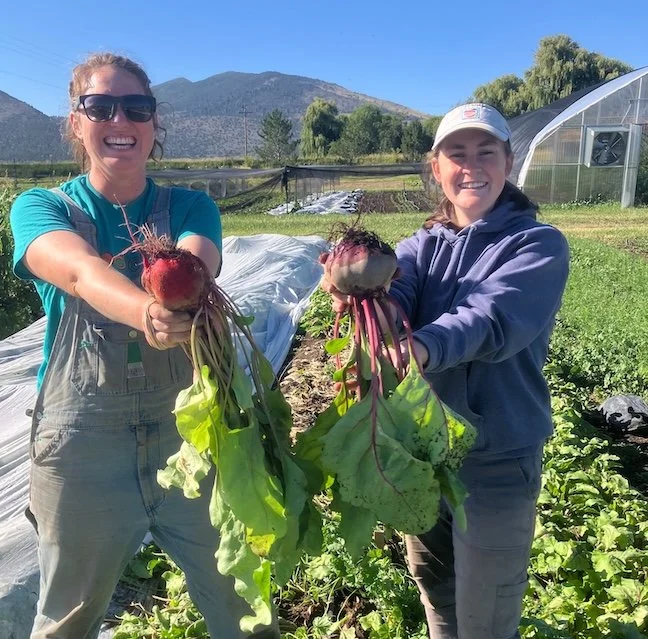
Farm Owner Katie Swanson and Staff with Beets
Winter Green Farm
WINTER GREEN FARM
2 APPRENTICESHIPS
FULL TIME (40 hours/week)
APPROX START/END DATES: March - November
$15.75/HR
LOCATION: Noti (WIllamette Valley Chapter)
YEARS IN PRODUCTION: 45 years
PREVIOUS YEARS HOSTING: 2
PRACTICES: Biodynamic, Certified Organic, Mechanized/Tractor Farming
ACRES IN CULTIVATION: 25
Vegetables, Fruit, Culinary Herbs, Meat Production, Hay Production
ON-FARM HOUSING? No
VEHICLE REQUIRED? Yes
LANGUAGES SPOKEN: English, Spanish
Women-Owned/Operated
Mission Statement:
A productive farm in harmony with the earth, humanity, and ourselves.
FARM OVERVIEW
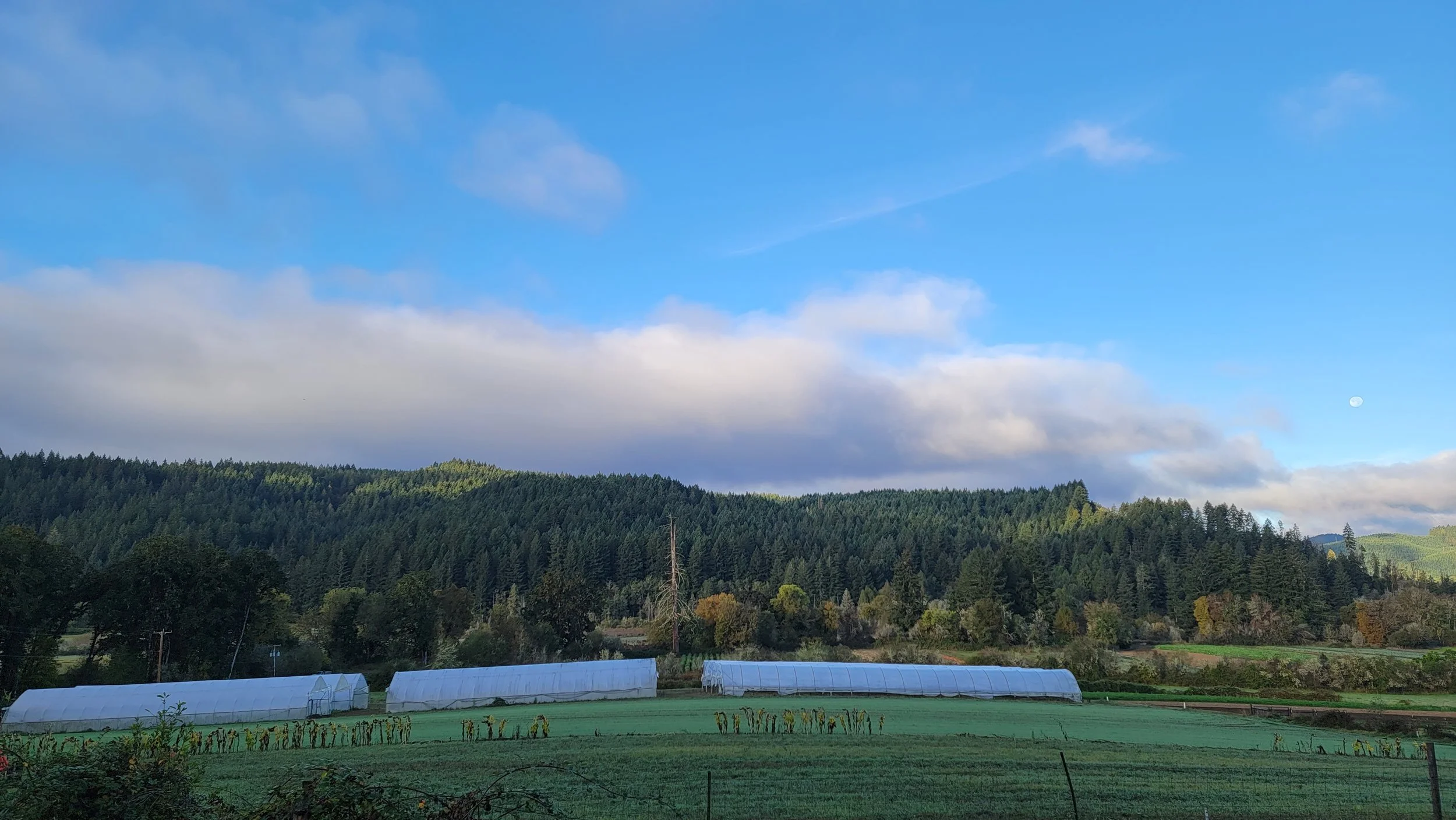
Winter Green Farm is owned and operated by Chris and Shannon. Our farm is nestled in the foothills of the coast range about 25 miles from Eugene and 40 miles from the Oregon coast. The farm is about 100 acres, and we lease 34 acres down the road as well. The closest town that offers basic amenities is Veneta which is five miles away.
Our farm enterprises include a CSA (500 members), 3 farmers markets a week, direct wholesale to stores and restaurants, plus wholesaling to schools, Organically Grown Company and a small grass-fed lamb operation. We grow 22-25 acres of mixed fruits and vegetables a year that are certified organic by Oregon Tilth. We also use biodynamic farming methods. We practice a six year rotation where our ground is mixed vegetables and forage production for our animals for three years, and then a beef herd managed by neighbors is on the farm for 3 years. We make all of our own compost on-farm which is our main source of fertility. We have an average of 20-25 people on payroll during the year.
Apprentices would work closely with harvest managers as the primary mentors, rather than the farm owners. We grow a variety of fresh market vegetables and most are hand harvested, although we do have specialized mechanical harvesting equipment. Most of our tillage and cultivation is mechanized and done with tractors.
Winter Green Farm was founded in 1980, has been certified organic since 1984, has had a CSA since 1992. Chris came to the farm in 1995 with no agricultural experience, a degree in biology and a commitment to help make the world a better place. His initial role on the farm was to help process medicinal herbs. He then went on to become the irrigation person. As his passion grew and knowledge base broadened, he was given more and more responsibility on the farm. In 2008 He and Shannon were given the opportunity by the other owners to partner in the farm and in 2015 they purchased all of the assets and secured a long term lease to run the vegetable operation on the farm.
TRAINING AND EXPECTATIONS
We are looking to teach people production agriculture. They will take part in planting, harvesting, and processing of fruits and vegetables. Depending on experience and aptitude they may also get to take part in tractor work and other equipment operation. Depending on experience and desire to learn, Apprentices will be exposed to record keeping, fertility management and food safety protocol.
Apprentices will be given all the training they need for tasks that they are asked to do. Ideally they would work on average 40 hours a Monday through Friday. If someone is interested in doing farmers markets, their schedule would be adapted so they would work on Saturdays and still average 40 hours/week.
Farming is hard work. An Apprentice should be able to work hard at an efficient pace during all types of weather. Time off is honored if scheduled in advance (unless for urgent needs). Apprentices will get paid sick time as well. We provide instruction by explaining, showing and working with the skill being instructed on. The people learning the task are given goals and techniques that we have worked on over the years to make the job more efficient , safe and less taxing on the body and mind. They will be given the chance to ask questions and work on their own after hands-on instruction is given. We follow up a couple of times after the training to make sure that the skill has been acquired and that the person is reaching their fullest potential at that skill demonstration, gaining independence, offering time for questions or field walks, regular check-ins/meetings, evaluation sessions, etc.):
QUALIFICATIONS
People with previous farm experience would be ideal but not necessary. We appreciate: outdoor work experience, a commitment to organic agriculture, attention to detail, good communication and listening skills. Will need a car.
It would be nice but not necessary to meet in person beforehand.
COMPENSATION / ACCOMMODATIONS
We start all crew workers at $15.75 an hour. Workers are given a 50 cent raise after 250 hours of employment and then raises are given based on hours accrued after that on July 1st and January 1st. Bonuses are given at the end of the year if the farm is profitable.
Every employee is given paid sick leave (up to 40 hours a year) and if necessary can get paid family leave as well.
Apprentices will receive a 1⁄2 share of our CSA and are able to access other farm produce as well.
EQUITY AND INCLUSION
We believe that workers have the right to meaningful work, fair treatment, and decent compensation. We are eternally grateful for the love and care that our employees invest in our farm. In a very real way our farm is the manifestation of the energy of our workers. Many deep relationships have developed over the years at the farm, among workers and between workers and owners. We see our workforce as our farm community and look forward to supporting this important aspect of our farm. Just as Winter Green Farm’s ecosystem exists within a global ecology, so does our social activity exist within a broader community and societal context. We believe that supporting local community organizations, specific cause related endeavors, and certain agricultural organizations are important. Similarly, we believe that by opening the farm as a place where members of the community can support us, we help strengthen the bonds of community and help heal the rural/urban divide.
PAST APPRENTICE TESTIMONIALS
“It is [a great farm] to learn about larger scale production.” - 2024
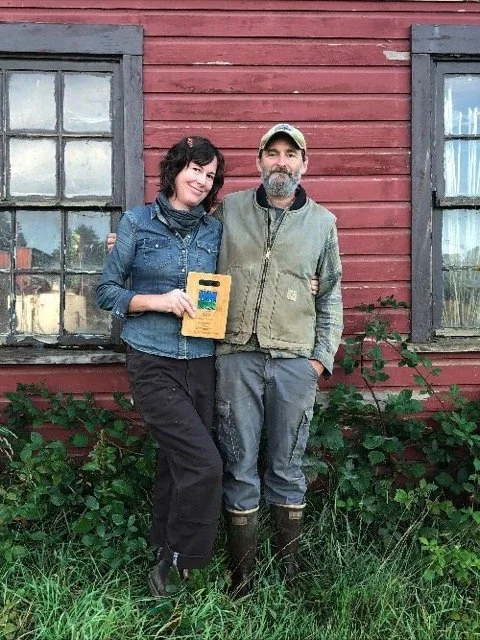
Shannon and Chris.

PCC ROCK CREEK LEARNING GARDEN-Full for 2026
PCC ROCK CREEK LEARNING GARDEN-Full for 2026
1 APPRENTICESHIP
PART TIME (14 hours/week)
APPROX START/END DATES: March - November
$16.30/HR
LOCATION: Portland (Portland Chapter)
YEARS IN PRODUCTION: 14
PREVIOUS YEARS HOSTING: 2
PRACTICES: Low-Till, No-Till, Organic Practices (Not Certified)
ACRES IN CULTIVATION: 3/4
Vegetables, Fruit, Culinary Herbs, Medicinal Herbs, Seed Production, Vineyard
ON-FARM HOUSING? No
VEHICLE REQUIRED? No
LANGUAGES SPOKEN: English , Spanish
Educational Farm
The PCC Rock Creek Learning Garden is part of a network of 5 gardens across the PCC district designed to create safe, welcoming, educational spaces that were built for and by students. The gardens promote interdisciplinary academic achievement, leadership development, curricular and co-curricular opportunities and model sustainable food systems through dynamic and responsive hands-on education. These living classrooms work to offer equity-centered learning opportunities, cultivate a sense of belonging and promote community on campus in our support of food sovereignty.
https://www.pcc.edu/sustainability/on-campus/rock-creek/rock-creek-learning-garden/
FARM OVERVIEW
Portland Community College is the largest higher education institution in the state of Oregon. The Rock Creek Campus rests on 250 acres of Tualatin Kalapuya land in Washington County, 20-30 minutes outside of downtown Portland. The Learning Garden is nestled near the main buildings on campus and consists of 3.5 acres with 50 fruit trees, 50 blueberries, grapes, brambles and many fruits and vegetables. Our campus is also home to wooded trails, the riparian habitat surrounding Rock Creek, a large recreational public park with sports fields operated by Tualatin Hills Park and Recreation District, as well as the 5 Oaks Museum.
The Learning Garden produces thousands of pounds of food each season, which are primarily donated to the food pantry on campus. We rely primarily on hand work, but also keep a new BCS walk-behind tractor just in case! We are no-spray, practice extensive cover cropping and are moving towards the production of our own usable compost. Our farm crew is always in flux - we have volunteer hours 10am-1pm Tuesday-Friday and we meet whoever is volunteering where they're at and re-prioritize based on inclusion.
The Learning Garden in its current iteration was established in 2012. Miriam has served as the Rock Creek Campus Learning Garden Coordinator since 2017. She ran her own 8-acre farm from 2011-2016, co-owned/operated a 25-acre production from 2006-2011, and worked on other peoples' farms from 1999-2003. She is interested in seed-saving, seed stories and the dignity of all living creatures.
TRAINING AND EXPECTATIONS
Crop-planning is collaborative. Greenhouse work begins in February. We plant, cultivate, harvest, wash and deliver food together. Efficiency does not dictate here! However, Miriam can offer insights based on her 15 years of production experience.
Our production is highly unpredictable because of our ethic of working in community, where building trust and creating learning opportunities are valued more highly than task completion. That said, because the majority of work is by hand, it is possible and probable that work will be physical and conditions may not always be easy.
The goal is to co-create a schedule that allows for 10-12 hours of labor in partnership, 1-2 hours of solitary labor pursuing a special project, and 45 minutes to an hour a week for check-ins, questions, and reflection.
QUALIFICATIONS
Willingness to learn, honest communication, reliability, and attention to detail
Considerate communication skills
A genuine delight for people and plants
COMPENSATION AND ACCOMMODATIONS
$16.30 per hour. The Apprentice can share in the harvest, seeds and entry into the PCC hiring system and diverse community of students, staff, faculty and campus neighbors.
The PCC Rock Creek site is located in a semi-urban area of Portland with various options for housing close by. There is low-cost housing in the area, and the campus is served by public transportation.
EQUITY AND INCLUSION
As LG coordinator Miriam has been building relationships for years with colleagues in Accessible Education and Disability Resources, the Dreamer Center, English for Speakers of Other Languages, and so many other departments on campus. This has guided the direction of the garden and created a welcoming space for everyone who wants to be in the garden.

Miriam, Learning Garden Coordinator